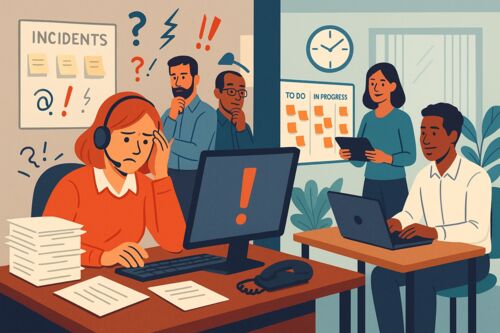
A composite story from IT service management. It draws on ABC of ICT by Paul Wilkinson and Jan Schilt, which argues that attitude, behavior, and culture decide whether IT works.
The ticket that kept coming back
Tessa, a second-line support engineer, opened the history of a printing error and counted five tickets with the same symptom. Each had been resolved. Each had returned within a few weeks.
The infrastructure team had deployed the documented fix and the service desk had published a workaround. Even so, every few weeks HR could not print contracts, Legal could not print briefs, and Procurement could not print purchase orders.
No step in the process had been skipped. Incidents were logged and linked to a problem record, the cause was analyzed, the fix was deployed and verified, and the record was closed with documentation.
What the closed record hid
Each team had a reasonable view of the situation, and the four views did not add up.
| Team | What they saw | What they could not see |
|---|---|---|
| Service desk | New incidents arriving, each escalated | That the problem record was already closed, and what became of their escalations |
| Infrastructure | A deployed driver fix and clean metrics | That users were still failing to print |
| Application support | Nothing, until someone asked | That the issue had returned at all, since nobody had added them to the record |
| Business users | Missed deadlines, repeated | Why IT seemed surprised each time they reported it |
The record closed when the fix shipped. Nothing in it measured whether people could print, and nobody was assigned to watch for recurrence. The information that would have shown the pattern was spread across four teams, and no one held all of it.
The cost was small each time. No major incident was declared and no executive escalated. Departments simply stopped expecting IT to fix this for good, and some kept their own workarounds, such as asking a colleague in another office to print for them.
The meeting
Leadership called one meeting with all four groups and a business representative. They did not review logs. Each group described what the past few months had looked like from where it sat.
The service desk learned that the record had been closed on the day the fix shipped. Application support learned the issue had come back at least five times. The business representative described the missed deadlines and the feeling of reporting the same fault to a team that treated it as new.
Nobody in the room had been negligent. The work had been divided so that every team finished its part and no team was responsible for the result.
What changed
- One owner for the outcome. A service lead, not an additional problem manager, followed the issue from the user’s first symptom to the point where printing worked again.
- Testing with real users. The fix was tried by the affected departments on their own machines before anyone closed the record.
- A recurrence window. The record stayed open for 30 days after the fix and closed only if no related incident came in.
- A shared record. The service desk and application support were added to the problem record and notified when its status changed.
- A written account. The record now states what failed, who it affected, and why it mattered, so the next person to open it understands the pattern.
The printing problem did not return.
What to take from it
A problem record can be correct and still leave the problem in place. The fix in this case worked from the first deployment. What failed was the closing criterion, which asked whether the change was made when it should have asked whether users could print.
If you want to check your own environment, look up the last problem you closed that later reopened. Find out who knew it had returned, who was told, and what the record required before it could close.