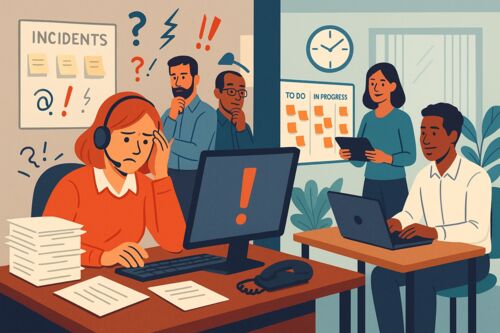
Why Incident Management fails
A composite story, built from patterns common in IT service organizations. It draws on ABC of ICT by Paul Wilkinson and Jan Schilt, which argues that attitude, behavior, and culture decide whether IT works.
Monday, 9:02 a.m.
The first call came from Berlin. A logistics coordinator said the inventory system had frozen mid-order, and she added that it had happened before. Ten minutes later Cologne called with the same problem. By 9:30 the phones at the service desk rang without a break, and the system was down across half the country.
Lisa, on the service desk, did everything the process asked of her. She logged each call, set a priority, and linked nothing, because nobody had told her calls could be linked. Then she looked at the queue. Dozens of tickets were open and not one had an owner on the operations side.
She escalated. Ten minutes later Mark, a senior systems engineer, picked up. “We’re looking into it.” Lisa asked for an ETA. “We’ve got fifty other things on our plate. You’ll hear from us when there’s something to say.”
By noon the customers were angry, and the service desk agents had run out of things to tell them. They apologized, stalled, and complained to each other in the break room.
Why the response failed
The escalation path existed, the SLAs were tracked, and the roles were documented. The response failed anyway, for reasons the process documents never covered.
Mark’s fifty other things were project tasks with deadlines that management reviewed every week. Nobody reviewed incident response time, so incidents lost every prioritization contest. No on-call rotation existed, and no one was named to run a major incident. Mark had no reason to update the service desk, because nothing in his job rewarded him for it and nothing punished him for staying silent.
The gaps went further:
- Nobody declared a major incident, so the outage was handled as a pile of individual tickets.
- Nobody linked the tickets or looked for a pattern.
- Nobody remembered that the same system had failed two weeks earlier. No record of that failure existed, so there was nothing to remember.
The customers’ complaint that it was happening again was accurate, and the organization had treated it as noise.
What changed
After the post-incident review, the service desk, operations, and a customer representative sat in one room for two hours and replayed the outage. Each person played another role. Mark took the service desk phone and fielded calls from people who wanted to know when their system would be back. He had no answer to give, and after twenty minutes he said so out loud.
The group then agreed on specific changes:
- A named incident owner for any outage that affects more than three customer sites.
- A status update to the service desk every 30 minutes, even when the update is “no change.”
- Incident work counted as planned capacity in sprint planning, so it no longer competes with project deadlines.
- Every repeat failure linked to the earlier ticket and reviewed as a problem record.
The next outage, six months later, was resolved in 70 minutes instead of the roughly seven hours Monday’s outage took.
Tickets also took on a different meaning. A ticket had been something to close. Now it was evidence: one repeated failure pointed to a weak component, and a cluster of calls pointed to a shared cause. The team started reading incidents for what they said about the system.
If your incidents keep returning, ask who owns the response when one starts, what they are measured on, and what the organization does with the second occurrence of the same failure.